When a company needs more software developers, QA engineers, DevOps specialists, or other IT professionals, the first instinct is often simple: “Let’s hire someone.”
Sometimes that is exactly the right answer.
But hiring a full-time employee is only one way to add technology talent. Companies can also use IT staff augmentation to add professionals to an existing team or IT outsourcing to hand responsibility for a project or function to an external provider.
The right choice depends on what you actually need: a permanent employee, additional capacity, specialized expertise, or someone to take ownership of an entire technology function.
And there is more to the decision than the hourly rate or annual salary.
Direct Hiring in the U.S.: More Control, More Commitment
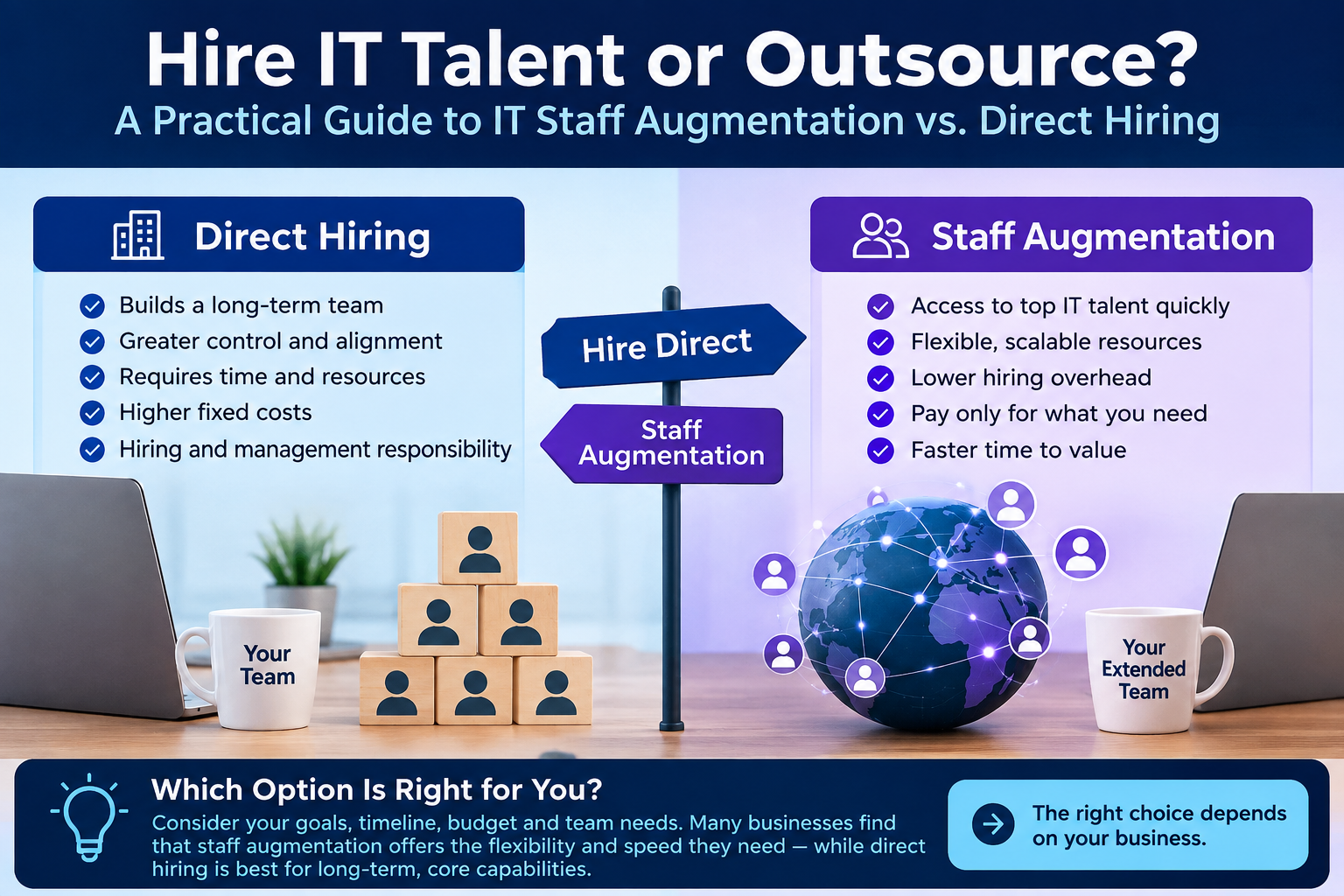
Direct hiring means bringing an IT professional onto your payroll as a full-time or part-time employee.
The model is straightforward: you recruit the candidate, interview them, make the offer, put them on payroll, provide the required benefits and employment protections, and manage their work directly.
It is often the best option when you have a long-term, predictable need.
For example, imagine a healthcare company is building a permanent internal engineering organization. It expects to maintain a product for years and wants the knowledge, architecture decisions, and technical expertise to remain inside the company.
Hiring a full-time software engineer may make perfect sense. But getting that person through the door takes more than posting a job.
What does direct hiring involve?
Depending on the company and position, the process may include:
- Defining the role and compensation range
- Creating and advertising the position
- Sourcing candidates
- Reviewing resumes
- Conducting technical and behavioral interviews
- Performing background or employment checks where appropriate
- Negotiating compensation
- Preparing an offer and employment documentation
- Completing payroll and tax onboarding
- Providing benefits
- Setting up equipment, accounts, security access, and software
- Training and onboarding the employee
And the work does not end once someone accepts the offer.
The company remains responsible for the ongoing employment relationship, including payroll, benefits, performance management, employee retention, compliance, and eventually termination or replacement.
How long does hiring take?
There is no single reliable number for how long it takes to hire an IT professional in the U.S. A straightforward hire can happen relatively quickly, while specialized or senior technology positions can take several weeks or even months.
The important point is that the time is not limited to the interview process.
If the internal team spends six weeks finding a candidate and another two weeks onboarding them, the business may have gone two months without the capacity it needed.
For a project already under pressure, that delay can be more expensive than it first appears.
The Cost of a U.S. Employee Is More Than Their Salary
One of the biggest mistakes companies make when comparing direct hiring with contracting is comparing a contractor's bill rate with an employee's salary.
Those aren't equivalent numbers.
An employee's compensation can include:
- Base salary
- Employer-paid Social Security and Medicare taxes
- Federal and state unemployment taxes
- Workers' compensation
- Health insurance
- Retirement contributions
- Paid vacation and holidays
- Sick leave
- Bonuses and other supplemental compensation
- Recruiting and hiring expenses
- Equipment and software
- HR and payroll administration
- Training and professional development
The U.S. Bureau of Labor Statistics provides a useful illustration. In March 2026, private-industry employers spent an average of $46.60 per hour in total compensation for every $32.60 spent on wages and salaries. Benefits accounted for the remaining $14.01 per hour. These are averages across private-industry workers, not IT-specific figures, but they demonstrate why salary alone does not represent the employer's total labor cost.
In other words, a $100,000 salary should not automatically be compared with a $60-per-hour contractor rate.
The real comparison is total cost of employment versus total cost of external delivery.
IT Staff Augmentation: Add People Without Adding Permanent Headcount
Staff augmentation sits between traditional hiring and outsourcing.
Instead of hiring an employee directly, a company engages an external provider to supply a qualified professional who works as part of the company's existing team.
The client generally controls the priorities and day-to-day work, while the staffing or technology provider handles the employment relationship with the professional.
For example: A retail company has an internal QA team but needs three senior QA engineers for nine months to support a major platform modernization.
Rather than creating three permanent positions, the company could augment its existing team with external QA engineers.
The augmented engineers can participate in the client's meetings, follow its development methodology, use its tools, and collaborate directly with its employees.
When the project is complete, the company can scale the external team back down.
Why companies choose staff augmentation
Staff augmentation can be particularly useful when a company:
- Needs talent quickly
- Has a temporary capacity problem
- Needs specialized expertise
- Has a hiring freeze or limited headcount
- Wants to avoid a permanent increase in payroll
- Needs to scale a team up or down
- Has internal managers who can manage the work
- Wants to maintain control over its technology roadmap
The major advantage is flexibility.
You don't necessarily need to make a permanent hiring decision to solve a temporary capacity problem.
But Isn't a Contractor More Expensive?
Sometimes the hourly rate will look higher.
That does not necessarily mean the overall cost is higher.
Suppose an engineer's salary is $100,000 per year. The employer's actual cost can be considerably higher after benefits, payroll taxes, insurance, paid time off, recruiting, equipment, HR administration, and other expenses.
A contractor might instead be billed at an hourly rate that appears substantially higher than the employee's calculated hourly salary.
But the contractor's rate may already incorporate some combination of:
- Recruiting
- Employment administration
- Payroll
- Benefits
- Employment taxes
- Workers' compensation
- Insurance
- Vendor overhead
- Account management
- Recruiting risk
- Provider margin
The economics depend heavily on the engagement.
A short six-month project can produce a very different financial result from a five-year requirement for permanent engineering capacity.
That's why comparing salary to bill rate is usually the wrong calculation.
Compare total cost of ownership instead.
IT Outsourcing: Don't Just Add People – Outsource the Responsibility
Staff augmentation still leaves the client responsible for managing the work.
Outsourcing is different.
With outsourcing, the client delegates responsibility for a project, service, or business function to an external provider.
For example, a company might outsource:
- Software development
- Software QA
- Application maintenance
- Cloud operations
- Help desk services
- Data engineering
- Cybersecurity operations
- A complete product development initiative
Consider a company that wants to build a new mobile application but does not have an internal software engineering organization.
Instead of hiring developers, QA engineers, a product manager, and DevOps specialists, it could engage an external technology company to deliver the product.
The provider may be responsible for assembling the team, managing delivery, establishing processes, performing testing, and meeting agreed-upon milestones.
That is outsourcing.
What About Insurance and Liability?
This is an area that deserves more attention than it usually receives.
When you hire someone directly, your company assumes the responsibilities of being their employer, including applicable payroll taxes, workers’ compensation, benefits, and other employment obligations.
When you work with a reputable IT staffing or services provider, the provider may handle many employment-related responsibilities for its employees, such as payroll, benefits, and workers’ compensation. However, using an external provider does not automatically eliminate your company's liability or risk.
A technology services agreement should clearly address:
- Workers’ compensation and general liability
- Professional liability / errors and omissions
- Cyber liability and data protection
- Confidentiality and intellectual property
- Indemnification
- Security requirements and access controls
- Background checks and subcontractor responsibilities
The appropriate coverage and allocation of responsibility depend on the nature of the engagement.
For example, a QA engineer testing an application presents a different risk profile from a provider operating production systems or accessing sensitive customer data.
The contract should reflect that difference.
What About Outsourcing Risk?
Outsourcing can reduce operational burden, but it does not eliminate risk.
In fact, outsourcing introduces a different category of risk: vendor dependency.
Before outsourcing an important technology function, companies should consider:
- Who owns the source code?
- Where is customer data stored?
- Who has access to production systems?
- What happens if the vendor misses a milestone?
- How quickly can the client terminate the engagement?
- What happens to knowledge when the contract ends?
- Are security and compliance requirements documented?
- Is there a transition or knowledge-transfer plan?
A good outsourcing agreement should make these expectations explicit.
The cheapest vendor is not necessarily the least expensive option if the engagement creates security problems, delays a product launch, or leaves the client unable to maintain the system after the relationship ends.
Direct Hire vs. Contracting: A Simple Example
Imagine a company needs five additional QA professionals.
Option 1: Hire five employees
The company must recruit, interview, hire, onboard, equip, manage, and retain five employees.
If the need disappears after nine months, the company still has permanent employees unless it restructures the team.
If the need continues for five years, direct employment may become increasingly attractive.
Option 2: Staff augmentation
The company contracts five QA professionals for nine months.
The external provider handles recruiting and employment administration. The client manages the day-to-day testing work and can scale the team based on project requirements.
This can be a good fit for a temporary increase in workload.
Option 3: Outsource QA
The company engages a QA services provider to take responsibility for testing a product.
Instead of simply supplying five people, the provider may be responsible for the QA strategy, test planning, execution, automation, reporting, and quality metrics.
The client is buying an outcome or service, rather than simply buying additional capacity.
So Which Model Is Better? The Best Answer May Be a Combination
In practice, companies don't have to choose just one model.
A company may maintain a core internal engineering team, augment it with external developers during periods of high demand, and outsource specialized QA or infrastructure work.
For example:
Internal team: Product management and architecture
Staff augmentation: Additional developers and QA engineers
Outsourcing: Performance testing or a specialized modernization project
This hybrid approach can provide something that neither model provides on its own: internal ownership combined with external flexibility.
The Bottom Line
The decision isn't really “employee or contractor?”
The better question is: “What capability do we need, for how long, and how much responsibility do we want to retain?”
If you need a permanent capability that is central to your business, direct hiring can be the right long-term investment.
If you already have the management structure but need more hands or specialized expertise, IT staff augmentation can provide flexibility without committing to permanent headcount.
If you need someone to take responsibility for delivering a project or operating a function, IT outsourcing may be the better model.
And when comparing the options, don't compare an employee's salary with a contractor's hourly rate. Look at the complete picture: time to hire, total employment cost, benefits, insurance, taxes, recruiting, management overhead, flexibility, risk, and ultimately the business outcome.
The lowest hourly rate is rarely the same thing as the lowest total cost.